Chinese cars are not cheaper in South Africa because their makers suddenly found a moral objection to profit. They are cheaper because Beijing built a system that lets them absorb costs other manufacturers must carry alone, then pushed that advantage into export markets where buyers are feeling the squeeze.
A Haval Jolion or Chery Tiggo 4 Pro now sits on a showroom floor with a price tag that can land uncomfortably close to a three to five year old European used car. For a buyer juggling instalments, fuel, tyres and school fees, that changes the entire decision. The second-hand market feels it first, and the local factories feel it later.
Beijing still sets the tempo
Chinese car companies look like a street fight when they are at home. They undercut one another, steal engineers, launch overlapping brands and race to put new battery tech into production before the next rival does. There is no cosy cartel here, and no polite agreement on prices or territories.
But the rivalry sits inside a larger system that Beijing controls closely. The State-owned Assets Supervision and Administration Commission, better known as SASAC, sits at the centre of that machine. It oversees state-owned groups such as SAIC Motor, BAIC Group, Changan, Dongfeng and Chery, while private firms like BYD, Geely and Great Wall Motor still operate within industrial rules set by the state and aligned to national targets.
That is the trick. The firms compete hard on the surface, but the direction of travel is set by the government. Five-year economic plans, New Energy Vehicle targets, forced mergers where needed, and state-backed lending all push the sector in the same strategic direction. Beijing behaves less like a referee and more like the conductor at the front of the orchestra.
The battery bill is being paid elsewhere
The first reason Chinese cars can land here so cheaply is simple. They start with a lower cost base.
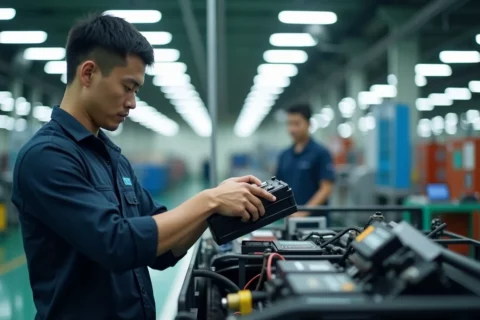
Batteries are the expensive part of the game, and China spent more than a decade propping up lithium refining and battery manufacturing. That matters because Western brands often buy cells or raw materials on the open market, sometimes from Chinese suppliers such as CATL and BYD anyway. Chinese brands, by contrast, have been building into a supply chain that is already local, heavily supported and vertically integrated.
That cost advantage shows up in South Africa as a fully loaded SUV or electric vehicle priced where a European rival is still trying to sell you a stripped-out entry model with a smaller engine and fewer toys. A premium Chinese plug-in or hybrid package can be priced like a compromise from an older badge.
Development costs do not bite the same way
The second advantage comes before a car ever leaves the factory gate. Vehicle development is expensive, and it can take billions of rand to bring a model to market.
State-owned Chinese groups can lean on large upfront research grants, subsidised land, and incentives that reduce the pain of bringing new technology into production. When those costs are softened before the first unit is sold, the pressure to recover every rand through the sticker price is far lower.
That is why some of these brands can settle for slim margins at launch and still flood a market quickly. A company trying to claw back private capital from scratch cannot behave like that for long. A state-backed group can.
Cheap credit changes the whole business model
The third mechanism is finance. European legacy carmakers answer to shareholders, lenders and the hard maths of profit. Chinese state-linked groups can tap softer loans from state-backed banks on terms that are far more forgiving.
That cheap capital has real consequences on South African soil. It helps fund big parts warehouses, warranty support and dealer expansion at a scale that would make a private European importer sweat. It is one thing to promise an 8-year or 10-year warranty. It is another thing to back that promise with financing that does not punish every slow month.
In the South African market, Chinese brands are reportedly already taking more than 36% of new financing loans. That is not a footnote. It is a shift in who gets to define the default choice on the dealership floor.
Export pressure has been redirected south
The fourth factor is overcapacity. China has built too much factory capacity, much of it with state support. At the same time, the United States and European Union have slapped import tariffs on Chinese vehicles, in some cases ranging from 10% to more than 100%.
So the excess does what excess always does. It goes where the barriers are lower. South Africa has become one of the target markets, not because local buyers were begging for a flood of Chinese cars, but because the system needed a place to send them.
That is why established European names are being forced into a price fight they did not design. Chinese brands can undercut them by 15% to 30%, and that is enough to change buying habits quickly.
Used cars are getting squeezed
The second-hand market is taking a punch from both sides. Buyers who would once have stepped into a used European hatch, sedan or SUV are now looking at a new Chinese model with a long factory warranty and a monthly payment that is close enough to tempt them.
WeBuyCars has felt that shift even while trading volumes remain high. In March 2026 it sold more than 17,200 units, but its premium stock is under margin pressure because the old used-car price ladder no longer holds the same shape. If a new Haval or Chery is parked in the same budget bracket as a 3-year-old German badge, the used car has to move down in price.
Dealers dislike that kind of maths. So do trade-ins.
Local plants are being squeezed from both ends
Volkswagen Group Africa’s Kariega plant in the Eastern Cape has spent 75 years as one of the country’s industrial anchors, and it is still the world’s biggest exporter of the VW Polo. Even so, 2026 has been framed as a make-or-break year for the plant. Local Polo and Polo Vivo demand is weakening, while Volkswagen AG is trimming global production capacity by 1 million cars. If export orders slip, the shock lands in the Eastern Cape first.
Mercedes-Benz South Africa’s East London plant is under strain as well. C-Class exports to the United States have fallen by about 80% because of trade barriers, which helped drag overall factory output down by 28%. Temporary shutdowns and restructuring have become part of the picture.
South Africa is trying to force a local answer
South Africa’s Automotive Master Plan 2035 aims to keep the country inside global supply chains, with a target of 1.4 million vehicles a year, 60% local content and 224,000 jobs by 2035.
The government has started using tax policy to pull investment toward local EV production. The 2024 Taxation Laws Amendment Bill gives a 150% tax deduction for qualifying investment in battery-electric or hydrogen vehicle production assets, including new buildings, plants, machinery and structural improvements. A R100 million EV assembly project can therefore produce a R150 million deduction. The rule applies to qualifying assets brought into use between 1 March 2026 and 1 March 2036, with a five-year clawback if the equipment stops being used for that purpose too soon.
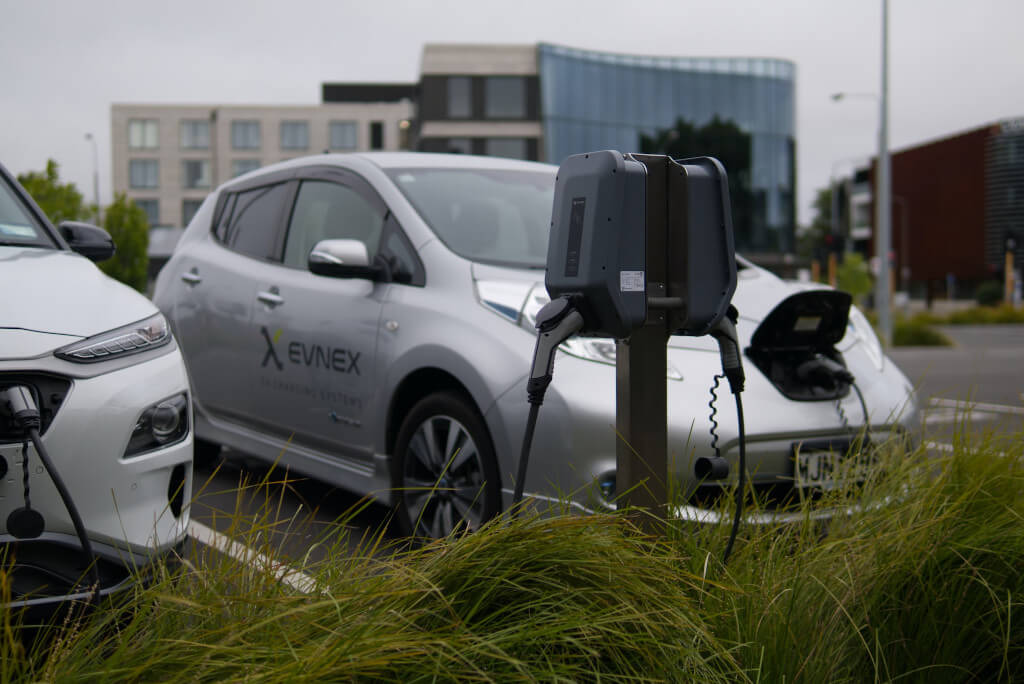
APDP2 was also amended so materials used in domestic EV battery assembly qualify for a 50% Standard Value Added allowance, up from 25% for normal components. Imported built-up EVs still face a 25% duty in South Africa, compared with 18% for combustion cars, before ad valorem tax is added.
The message is plain enough. If foreign brands want South African sales without eating high tariff pain, they will need to build here. That is why the talk around Chery and other Chinese groups is shifting from imports alone to permanent manufacturing footprints. South Africa wants beneficiation, local batteries, and a future where manganese and platinum leave the country as higher-value components, not just raw rock.