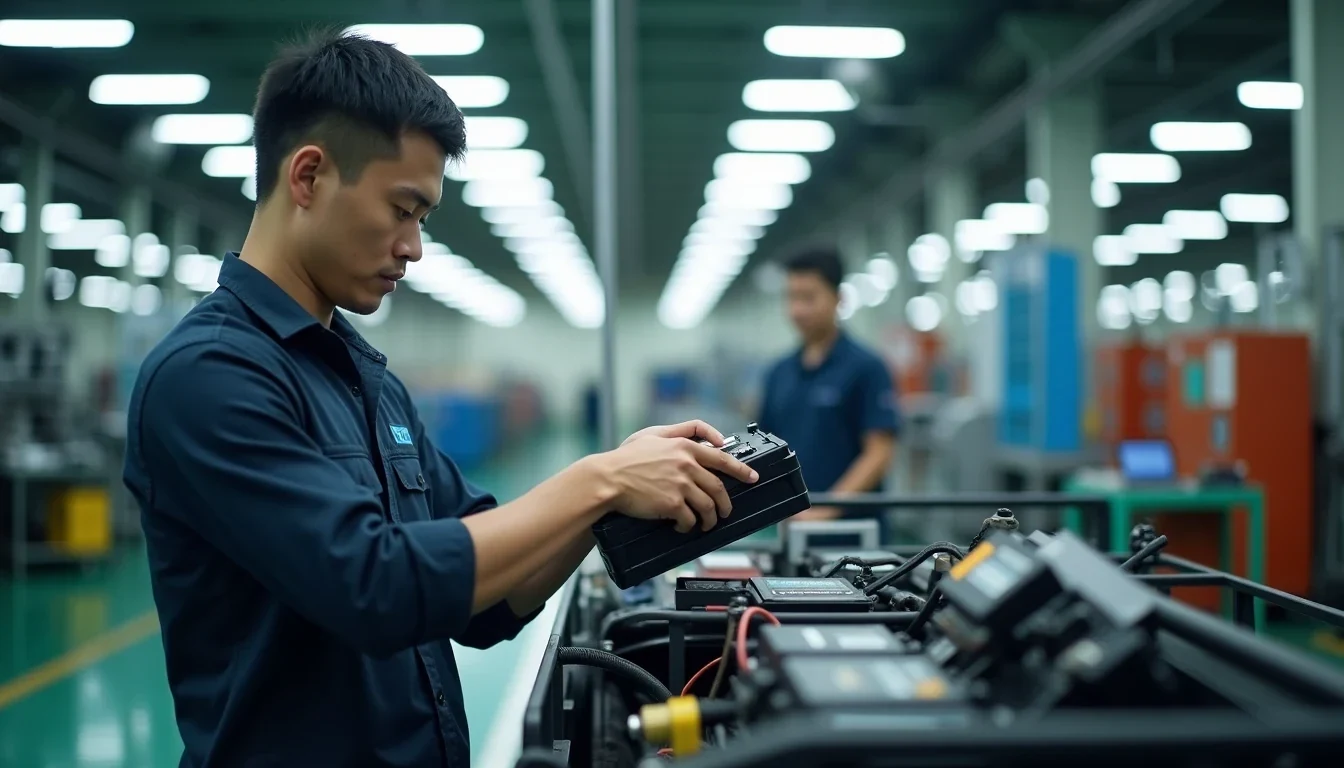
Toyota’s decision to build the electric Hilux in Thailand, not here, should have changed the conversation. A bakkie that has defined South African roads for decades, assembled in Rosslyn since 1962, will see its battery-powered successor roll off lines in Rayong instead. The government had already put a 150% tax deduction on the table for qualifying EV and hydrogen production investment. Toyota took the incentive, looked at it, and chose somewhere else.
Thailand’s offer reveals what actually wins these decisions. Thailand did not outbid South Africa on tax breaks alone. It offered a grid that stays on, ports that move freight on schedule, and a workforce already pivoting toward battery-electric assembly. The 150% deduction here is real money, and Treasury designed it to signal seriousness about keeping automotive investment onshore. Automakers are not shopping for the best subsidy. They are shopping for the lowest total risk over a twenty-year production cycle, and South Africa is still asking them to factor in diesel generators and harbour delays as line items.
The Scale of What Stands to Move
Automotive manufacturing is not a peripheral industry looking for a handout. It generated 23.8% of all manufacturing output in 2023. Direct employment sits at roughly 113,000 people, with another 498,000 jobs supported through components, logistics, retail, and services. Two out of every three vehicles built here ship overseas, mostly to Europe and African markets. The sector’s health is not merely a domestic concern; it is a foreign exchange engine, a skills pipeline, and the anchor tenant for industrial policy.
The transition to electric powertrains was always going to test this model. Internal combustion engine plants retool slowly and expensively. Battery supply chains require different raw materials, different suppliers, and different quality control regimes. The question was whether South Africa’s existing automotive footprint would translate into first-mover advantage for EV production, or whether the country would find itself holding mature assets in a declining technology. Toyota’s Hilux decision suggests the answer is drifting toward the second option.
What the 150% Deduction Actually Buys
The tax incentive itself is structurally aggressive. For every Rand invested in qualifying EV or hydrogen vehicle production, companies can deduct R1.50 from taxable income. This sits within the broader Automotive Production and Development Programme and its successor framework, the SA Automotive Master Plan 2035, which also dangles cash grants of 20% to 35% for productive asset investment and pushes local content targets toward 60% by 2035.
These are not trivial numbers. They reflect a government that understands the sector’s employment and GDP contribution and is willing to forgo revenue to preserve it. But the same Treasury offering these deductions cannot guarantee that the factory receiving them will have uninterrupted power for its welding robots or paint booths. Eskom’s load shedding has become background noise in domestic conversation, yet for a capital-intensive investor running continuous-shift assembly, it is a quantified operational cost with no ceiling. Backup generation adds capex, burns diesel, and still cannot fully replicate grid stability for precision manufacturing processes.
The Infrastructure Gap in Hard Terms
Electric vehicle production intensifies every existing infrastructure vulnerability. Battery cell and pack assembly are power-hungry operations where voltage fluctuation can scrap entire batches. South Africa’s grid instability is a direct quality risk. Thai factories, by contrast, draw from a generation mix that has expanded capacity faster than demand growth, with industrial estates offering redundant feed reliability as a standard utility feature rather than a negotiated premium.
Logistics tell a similar story. Durban and Ngqura have ranked poorly in global port efficiency indices, congested by equipment failures, labour disputes, and throughput limitations that push freight onto roads already strained by rail underperformance. For an export-dependent industry where just-in-time component delivery intersects with just-in-time vessel scheduling, these delays compound. A Thai-built Hilux EV reaches its European or Australian market through Laem Chabang, a port that moved 7.4 million TEUs in 2023 with scheduled reliability that Durban has not matched in years.
The skills pipeline presents a slower-burning but equally structural problem. South Africa’s automotive workforce knows internal combustion. Toolmakers, drivetrain specialists, and engine calibration engineers built their careers on mechanical systems that are now plateauing. Battery management systems, power electronics, and the software integration that defines modern EV architecture require different foundations. Universities and technical colleges are adapting curricula, but the lead time from classroom to factory floor runs years, and competing hubs already have graduates walking into EV-specific roles.
The Real Risk Is Not Closure But Absence
Existing South African automotive plants are not about to vanish overnight. The BMW X3 built in Rosslyn, the Ford Ranger in Silverton, the Volkswagen Polo in Kariega, these are profitable programmes with committed model cycles and established supplier ecosystems. The danger is more insidious. When those programmes reach end-of-life, when the next platform architecture is allocated globally, the EV variants go to Thailand, to Mexico, to Eastern European hubs that solved the foundational questions first.
That is the pattern Toyota has established with the Hilux. The internal combustion version will likely continue here for years, satisfying African and export markets where demand for petrol and diesel bakkies persists. But the electric derivative, the one that maps to tightening European emissions rules and the trajectory of global demand, will be stamped with Thai VINs. South Africa keeps the present. It loses the future.
Chinese manufacturers illustrate the same dynamic from a different angle. BYD and Chery are expanding sales and distribution networks here aggressively. Their showroom presence in Johannesburg and Cape Town is unmistakable. Yet their manufacturing investment for right-hand-drive EVs remains concentrated in Chinese and broader Asian production bases. They see South Africa as a market to sell into, not yet a place to build from.
What Competitiveness Actually Requires
The framing of this challenge often drifts toward a false choice between incentives and infrastructure, as if Treasury could simply reallocate from one to the other. Both must function in parallel. The 150% deduction gets a foot in the door. It gets the feasibility study, the board presentation, the initial site visit. But the decision to commit billions in capital over two decades happens in the due diligence that follows, when engineers walk the grid interconnection, when logistics teams model port throughput scenarios, when HR assesses whether local hires can be trained to battery-grade standards fast enough.
South Africa has the industrial heritage, the trade agreements, and the geographic position to remain a serious automotive manufacturing contender. What it lacks is the operational predictability that converts those advantages into signed investment decisions. The tax break is a necessary condition. It has never been sufficient, and Toyota just proved it in the most public way possible.